Key Features:
-
Dual MFR & MVR Analysis: Comprehensive measurement of mass and volume flow rates for diverse polymer types.
-
International Standard Compliance: Fully adheres to ISO 1133, ASTM D1238, and ASTM D3364 testing protocols.
-
Advanced Automation: Features an automatic motorized sample cutter and integrated printer to eliminate human error.
-
Intuitive Interface: Large LCD touch screen provides real-time MVR curve displays and modular testing flexibility.
-
Precision Temperature Control: Intelligent PLC system ensures stable furnace heating for high and low-melt resins.
The Melt Flow Indexer is designed to determine the melt mass-flow rate (MFR) and melt volume flow rate (MVR) of thermoplastic as well as test the high melt temperature such as PC, Fluor plastics, and nylon, but also PE, PP, POM, PS, ABS resin which has low melt temperature. This testing machine is designed to perform tests according to AS, ASTM and ISO standards.
The specimen is melted under high temperature by heating the furnace. The melted specimen flows out a specified hole under the given load. In plastic producing activities, we usually use the melt index to measure the physical properties of the polymer, such as the fluidity or mucosity, etc.
Parts of the Melt Flow Indexer
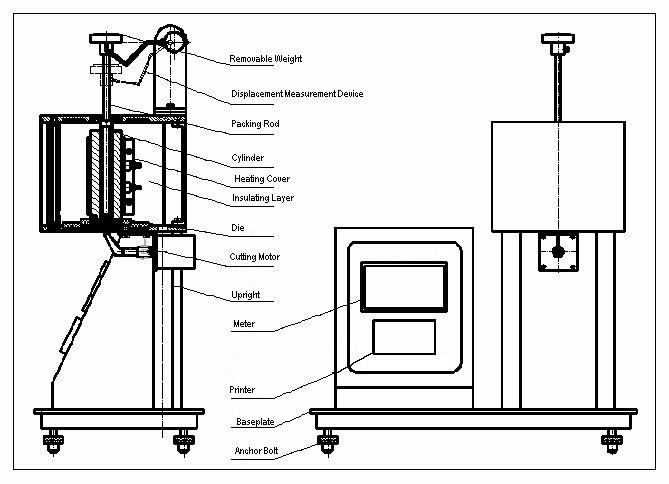
Monitor: A touch screen LCD. Operate the tester according to the relative dialogue box. Touch the relative dialogue box or button to input the test parameters and the relative page shows the test temperature, the rod displacement and the real-time curve of MVR.
Printer: When the test ends, input the mass value of the melted specimen to check or print the MFR test data as well as check or print the data directly.
PLC: Receive the orders from the touch screen to measure and control the furnace temperature and determine the displacement of the load rod.
Furnace Chamber: Consists of heating cover, cylinder, die load rod and removable weights.
Spatula: Made up of the motor, the cover and the edge. The motor drives by the tester and rotates automatically to make the edge cut the sample so as to avoid the human error of manual cut.
Displacement Sensor: Installed at the upper right back of the tester, together with the load rod, measures the displacement of the load rod.
Melt Flow Indexer Technical FAQs
Q1: What is the difference between MFR and MVR in melt flow testing?
Melt Mass-Flow Rate ( MFR) measures the weight of a polymer (in grams) extruded through a specific die over 10 minutes, while Melt Volume-Flow Rate ( MVR) measures the volume (in cm³). MFR is standard for general quality control, whereas MVR is essential for evaluating materials with high filler content or varying densities, as it accounts for the melt density of the thermoplastic under high-temperature conditions.
Q2: Which international standards does the LAR-XNR-400D comply with?
The Automatic Melt Flow Indexer is engineered to meet and exceed global testing requirements, including ISO 1133 (Parts 1 and 2) for MFR and MVR, ASTM D1238 for standard extrusion plastometer testing, and ASTM D3364 for flow rates of PVC. This ensures that test results are valid for international export and regulatory compliance.
Q3: Can this melt flow indexer test both high and low-temperature resins?
Yes. The intelligent heating system is designed for a broad thermal range. It effectively tests high-melt temperature polymers such as Polycarbonate (PC), Fluoroplastics, and Nylon, as well as low-melt temperature resins including PE, PP, POM, PS, and ABS. The modular PLC control ensures temperature stability across all material types.
Q4: How does automation improve melt flow test accuracy?
Automation significantly reduces human error, which is the leading cause of data variance in manual testing. By utilizing an automatic motorized spatula (cutter) and a displacement sensor, the instrument ensures precise cut timings and consistent load rod measurements. This results in higher repeatability and more reliable data for R&D and production quality logs.
Q5: Why is Melt Flow Index (MFI) testing important for plastic manufacturing?
MFI testing is a critical quality control metric used to determine the viscosity and flowability of a polymer. It helps manufacturers verify that incoming raw materials meet specifications, ensuring consistent processing during injection molding or extrusion. A stable MFI is vital for maintaining the structural integrity and physical properties of the final plastic product.